Case study. R / Shiny / RAG.
DevSight
Hybrid-RAG deviation investigation assistant
Internal enterprise application, built at Takeda Pharmaceutical
- Role
- Full-stack: indexing pipeline, two-stage RAG, app
- Status
- Decommissioned 2026final v2.7.0
- Context
- Takeda LA
- Search-time reduction
- 93%
- Self-reported satisfaction
- 4.8/5
- Resolved cases indexed
- 2,213+
- Searchable chunks
- 31,577
~30 min to ~2 min per query, measured in production
Self-reported by users
Four years of records, 2022 to 2026
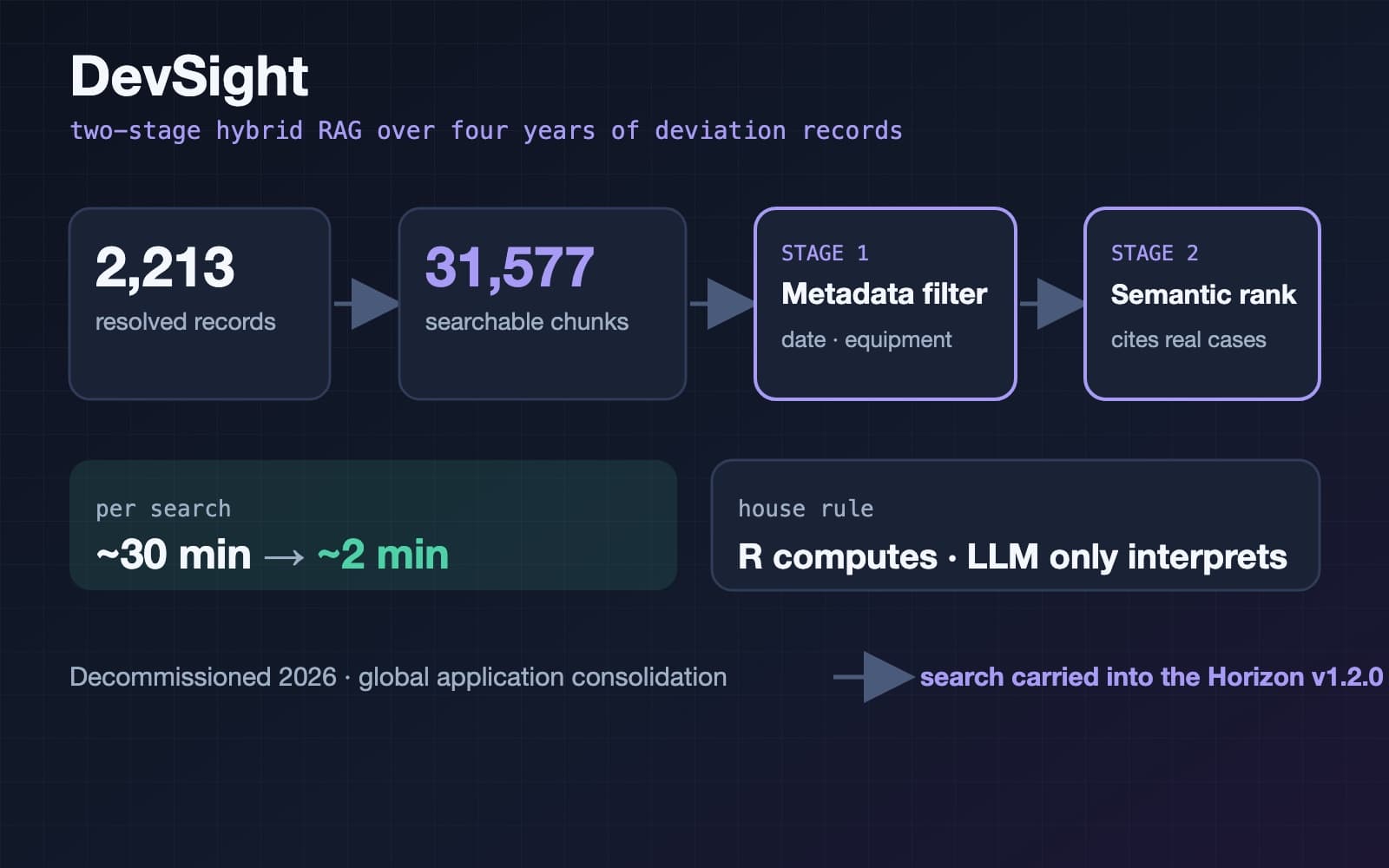
Two-stage hybrid RAG index
The problem
Investigating a new deviation meant manually keyword-searching four years of Trackwise records — roughly 30 minutes per question, and brittle: the right precedent was easy to miss if it used different wording. Investigators needed semantic recall over 2,213+ resolved cases without leaving the 30-day closure window.
Architecture
- 1.Deviation source
- 4 yrs deviations
- 2,213+ cases
- 10 fields
- 2.Index
- Chunk → 31,577 units
- Embed
- Databricks Vector Search
- 3.Stage 1 — Filter
- Date metadata
- Equipment pre-filter
- 4.Stage 2 — Semantic
- Vector rank
- Post-filter client-side
- 5.Answer
- Streamed via ellmer
- Cites real cases
- 10-turn memory
How it is kept honest
Two-stage hybrid RAG: a date-metadata filter narrows the candidate set, then semantic vector search ranks across ten record fields. The assistant answers from retrieved records and streams the synthesis; it does not derive new figures.
- Guardrails
- Date filtering applied client-side after the vector search
- Conversation memory limited to the last 10 turns
- Document upload limited to Word and Excel on purpose, to preserve streaming
- How correctness is checked
- Search time was measured in production at roughly 30 minutes down to 2 per deviation query; satisfaction was self-reported at 4.8/5.
- Where it can still be wrong
- Recall depends on the index: 2,213 records as 31,577 chunks, 2022 to 2026; a precedent outside that window is not found
- Decommissioned in 2026 during a global application consolidation; the search lives on in the Horizon proof of concept and in BioTrack
Reliability and scale
- The final v2.7.0 release removed roughly 2,200 net lines while adding dark mode, an accessibility pass and a tokenized component library
- The vector index is shared: BioTrack reuses it for a search scoped to bioburden investigations
What it did
DevSight (formerly TrackLA) was a hybrid-RAG assistant over four years of Trackwise deviations, 2022–2026: 2,213+ resolved cases chunked into 31,577 searchable units. It replaced ~30-minute manual keyword searches with ~2-minute semantic ones — a 93% time reduction — and surfaced the actual precedent cases behind every answer, so an investigator could check the source instead of trusting the summary.
Two-stage hybrid RAG
Search ran in two stages: a date-metadata filter narrowed the candidate set, then semantic vector search ranked across 10 Trackwise fields. Date filtering happened post-search, client-side — a deliberate workaround for Databricks Vector Search not handling DATE range operators cleanly.
- Conversation memory across the last 10 turns
- Real-time token streaming with voice input and read-aloud
- Document upload limited to Word and Excel — image and PDF disabled on purpose, to preserve streaming
- Mobile-optimized with a fixed input bar, for use away from a desk
The final release
v2.7.0 was a design-system rewrite that removed roughly 2,200 net lines while adding dark mode, an accessibility pass and a tokenized component library — the codebase got smaller as capability grew. It also introduced a single APP_VERSION constant as the source of truth for every version string, and self-hosted fonts because the plant floor blocks CDNs.
Why it was decommissioned
DevSight was decommissioned in 2026 during a global application consolidation: the site moved onto standardized global applications, and locally built tools in that space were wound down regardless of how they were performing. That was a portfolio decision, not a verdict on this application. At the time it held a self-reported 4.8/5 satisfaction score, was still delivering the search-time reduction it launched with, and had shipped its largest release — v2.7.0, the final one — in its last month of operation.
What survived
The capability outlived the app. On 2026-08-14 the general-purpose search was merged into the Horizon v1.2.0 proof of concept as pure R utilities plus one Shiny module with its own tests, and BioTrack uses the same vector index for a search scoped to bioburden investigations. Retiring an application and retiring a capability are different decisions, and only the first one was made.
Stack
- R Shiny
- Databricks Vector Search
- ellmer
- Hybrid RAG